
Decoding the Texas Helmet Law
Understanding the helmet law in tx is crucial for every rider hitting the open roads of Austin, Cedar Park, and Round Rock. Here’s a quick look at what you need to know:
| Requirement Summary | Details |
|---|---|
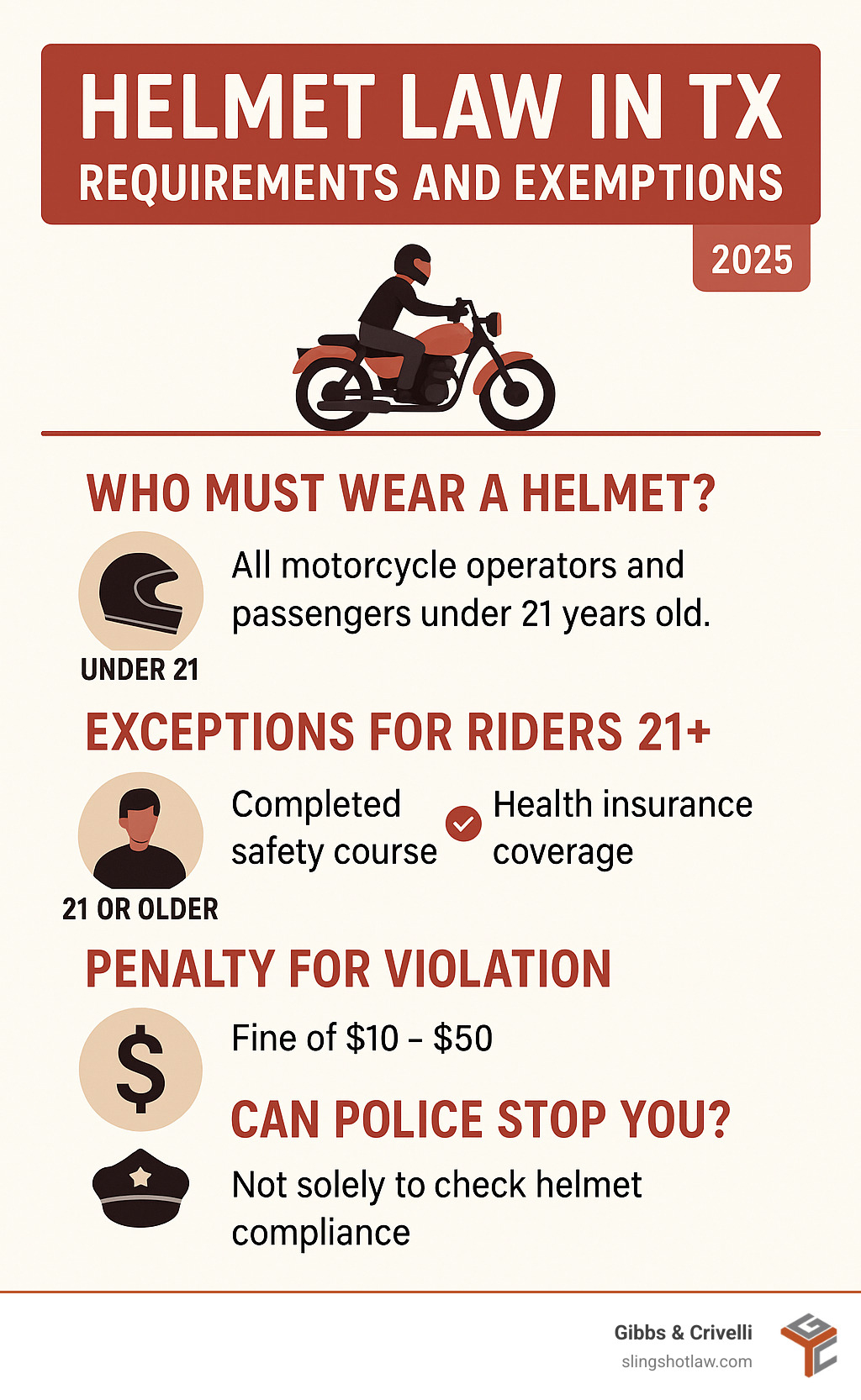
| Who Must Wear a Helmet? | All motorcycle operators and passengers under 21 years old. |
| Exceptions for Riders 21+ | Riders aged 21 or older are exempt if they have successfully completed a state-approved motorcycle operator training and safety course OR are covered by a health insurance plan providing at least $10,000 in medical benefits for motorcycle accident injuries. |
| Can Police Stop You? | Peace officers cannot stop or detain a person solely to check if they meet these helmet law exceptions. |
| Penalty for Violation | A misdemeanor offense, punishable by a fine between $10 and $50. |
Riding a motorcycle in Texas offers a unique sense of freedom, but it comes with important responsibilities regarding safety and the law. For many riders, the rules around helmets can seem unclear. This guide will help you understand Texas helmet laws, including who must wear a helmet, what makes a helmet legal, and how these rules can affect you after an accident.
The Core Rule: Who Must Wear a Helmet in Texas?
Texas Transportation Code § 661.003 lays out the requirements for motorcycle helmet use. The law balances the state’s value of personal liberty with critical safety considerations, particularly for younger riders.
The core of the helmet law in tx is straightforward: it’s primarily about age. However, there are unique nuances for adult riders. Understanding these specifics is the first step toward riding safely and legally, whether you’re cruising through the Hill Country near San Marcos or navigating the busy streets of Killeen.
Riders Under 21: A Strict and Simple Mandate
For anyone under the age of 21, the helmet law in tx is crystal clear: you must wear a motorcycle helmet. This applies to both operators and passengers on public roads, with no exceptions for minors.
This mandate is in place to protect our youngest and often less experienced riders from the devastating consequences of an accident. If you’re under 21 and riding in Texas, whether in Pflugerville, Temple, or Georgetown, always wear a helmet. It’s not just the law; it’s a vital layer of protection.
Riders 21 and Older: Understanding Your Two Paths to Exemption
For riders 21 and older, the helmet law in tx offers more flexibility. While wearing a helmet is always the smartest choice, Texas allows adults to opt out, provided they meet one of two specific criteria.
If you plan to ride without a helmet, you must meet one of these conditions and be able to provide proof if requested:

-
Successful completion of a Texas Department of Public Safety (DPS) approved motorcycle operator training and safety course. This course improves your riding skills, teaches defensive strategies, and boosts your confidence on two wheels.
-
Proof of a valid health insurance plan that provides at least $10,000 in medical benefits for injuries from a motorcycle accident. This ensures you have a financial safety net for medical expenses. A standard health plan from an employer, a group plan, Medicare, or Medicaid is generally considered sufficient proof. However, specialized policies like life or cancer-only insurance do not meet this requirement.
If you choose to ride without a helmet under one of these exemptions, it’s wise to carry your course completion certificate or proof of insurance. While officers cannot stop you solely to check for these exemptions, they can verify your compliance if you are pulled over for another reason.
Understanding the Official Helmet Law in TX
Navigating the roads of Texas, from Austin to the quieter routes of Harker Heights, requires understanding the legal specifics of the helmet law in tx. It’s not a suggestion but a part of our state’s Transportation Code, with requirements for helmets, enforcement, and penalties. The Texas Department of Public Safety (DPS) sets the standards for what constitutes a “legal” helmet.
What Makes a Helmet “Legal”? DOT and ANSI Standards
The helmet law in tx specifies that protective headgear must meet certain safety standards to be considered legal.
-
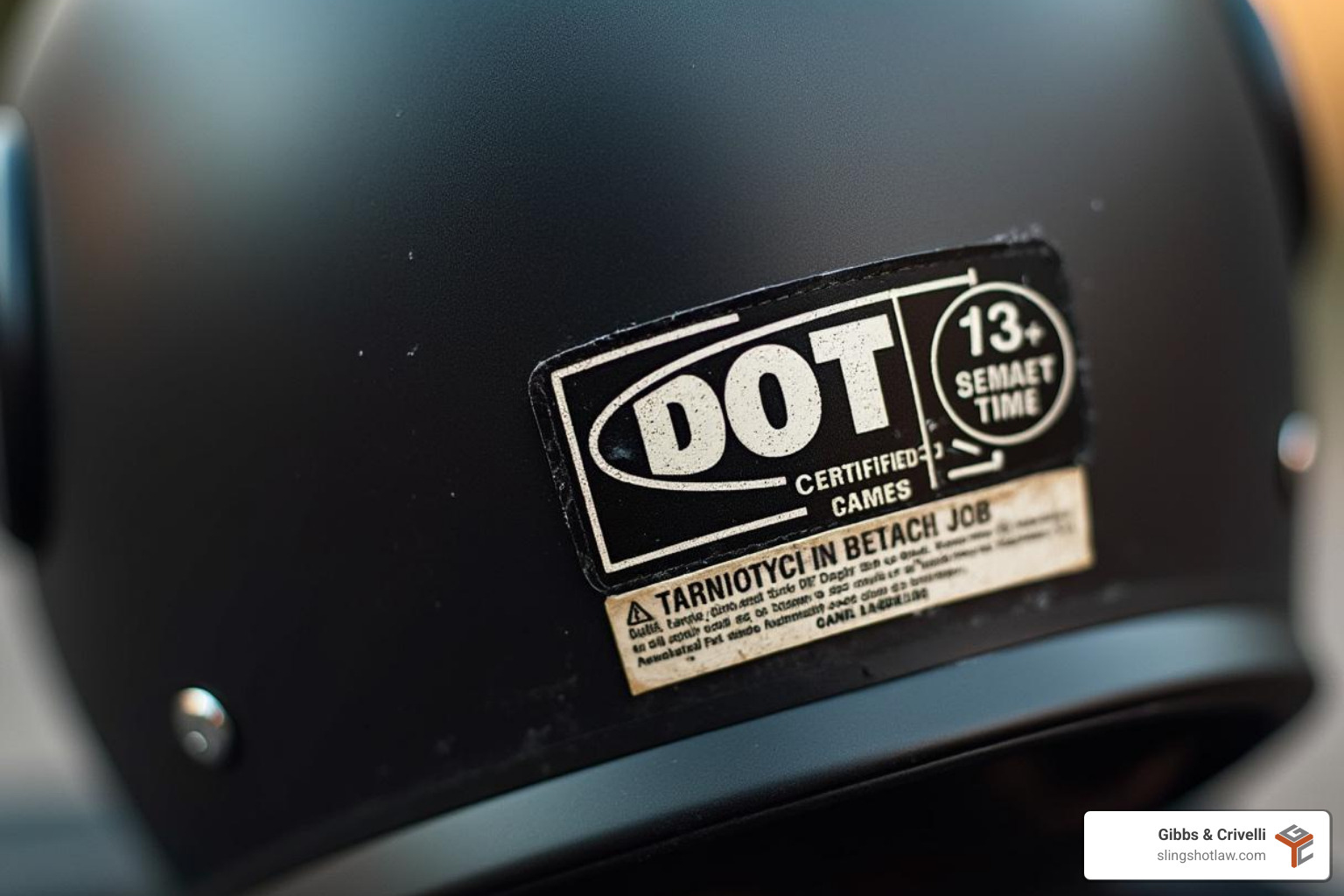
U.S. Department of Transportation (DOT) Compliance: The primary standard is the Federal Motor Vehicle Safety Standard (FMVSS) No. 218. When shopping, always look for the DOT certification sticker on the back, which indicates the helmet meets federal safety requirements for impact protection.
-
Other Certifications: While DOT is the federal minimum, certifications from organizations like the American National Standards Institute (ANSI) or the Snell Memorial Foundation often indicate a helmet exceeds basic standards, offering even greater protection. Choosing a helmet with multiple certifications is always a wise decision.
The best helmet is one that fits properly, is comfortable, and meets or exceeds safety standards. A helmet’s effectiveness is greatly reduced if it doesn’t fit correctly. It should be snug, but not painfully tight, and should not move around on your head. For more detailed guidance, we recommend the NHTSA’s guide: How to choose the right motorcycle helmet from the NHTSA.
Enforcement and Penalties: Can Police Stop You for No Helmet?
A common question we hear concerns enforcement. Texas law has a unique provision:
Peace officers cannot stop or detain a person who is the operator of or a passenger on a motorcycle for the sole purpose of determining whether the person has successfully completed the motorcycle operator training and safety course or is covered by a health insurance plan.
In plain English, this makes not wearing a helmet a “secondary offense” for exempt riders over 21. An officer cannot pull you over just for not wearing a helmet. However, if you are stopped for another traffic violation—like speeding—they can then ask for proof of your exemption. If you cannot provide it, you could be cited.
The penalty for violating the helmet law in tx is a misdemeanor offense, with a fine between $10 and $50. While the fine is low, a citation is a hassle and might be noted on your driving record. It’s always best to be compliant, especially when riding through communities like Round Rock or Killeen.
Does the helmet law in TX apply to other vehicles?
The helmet law in tx applies differently to various vehicles.
-
Mopeds: Mopeds are generally treated like motorcycles under the law. The same rules apply: mandatory for those under 21, with the same exemptions for those 21 and older.
-
Autocycles: These three-wheeled, non-straddle vehicles (e.g., Polaris Slingshot) are specifically defined in the Texas Transportation Code and are exempt from the helmet law.
-
Bicycles: There is no statewide helmet law for bicyclists in Texas. However, many cities, including Austin, have local ordinances requiring helmets, often for minors. Always check local city ordinances before you ride, whether in Georgetown or elsewhere.
Understanding these distinctions is important for compliance and safety. For more information on how negligence laws might apply, you can review our guide on Texas Negligence Laws Explained.
Beyond the Law: The Life-Saving Importance of Helmets
While the helmet law in tx defines legal requirements, the conversation about helmets goes far beyond rules. At Slingshot Law, we believe wearing a helmet is one of the most critical safety choices a motorcyclist in Austin, Cedar Park, or Round Rock can make. The facts clearly show the risks of riding and how much a helmet can protect you.
Motorcycling carries higher risks than driving a car. Riders are more exposed and less visible, making protective gear like a helmet essential to prevent serious injuries.
The Hard Facts: Texas Motorcycle Accident Statistics
Statistics from the Texas Department of Transportation (TxDOT) and other sources highlight why we strongly encourage everyone to wear a helmet:
- In a recent year, 562 motorcyclists died in Texas, accounting for 17% of all motor vehicle fatalities.
- The fatality risk for motorcyclists is 24 times higher than for occupants of passenger cars.
Helmets are proven to help:
- They are 37% effective in preventing death for operators and 41% effective for passengers.
- Helmets reduce the risk of head injury by about 69%.
Serious head injuries, or traumatic brain injuries (TBIs), can be life-altering. Helmets are your main defense against these outcomes. Even for skilled riders, a helmet can be the difference between walking away and a devastating injury, as you can’t control other drivers or road hazards.
The CDC advocates for universal helmet laws to save lives and money. While Texas law differs for adults, the data is clear: helmets save lives and prevent severe injuries. For more detailed information, you can check out the CDC data on helmet effectiveness.
How Not Wearing a Helmet Can Impact Your Injury Claim
Legally riding without a helmet can still complicate your personal injury claim. Insurance companies will use any reason to reduce your compensation, and not wearing a helmet is a common tactic they employ.
Texas follows a “modified comparative negligence” rule. If you are found partially at fault for your own injuries, your compensation is reduced by your percentage of fault. If you are 51% or more at fault, you receive nothing.
Here’s how not wearing a helmet can affect your case:
- The “Helmet Defense”: The at-fault party’s lawyers will often argue that your injuries would have been less severe if you had worn a helmet, claiming you contributed to your own harm.
- Reduced Compensation: Even if the accident wasn’t your fault, if a jury agrees with the helmet defense, your compensation for medical bills, lost wages, and other damages can be significantly reduced.
- Legal Problems: At Slingshot Law, our job is to fight these arguments. However, the “helmet defense” creates a significant legal challenge that can complicate your case.
While you may have the legal right to ride without a helmet if you meet Texas’s exemptions, doing so poses a risk to your physical well-being and your ability to get full compensation after a crash. For more details, read our article: More info about Comparative Negligence and Its Impact on Car Accident Claims in Austin.
Frequently Asked Questions about Texas Motorcycle Laws
The helmet law in tx and other motorcycle rules can be confusing. Riders in communities like Austin, Cedar Park, and Round Rock often have similar questions. We’ve gathered some of the most common ones to give you clear, straightforward answers to help you ride safely and legally.
What is the “5-year rule” for motorcycle helmets?
The “5-year rule” is a manufacturer guideline, not a legal requirement under the helmet law in tx. It suggests replacing your helmet every five years, even if it looks fine and hasn’t been in a crash.
Over time, the protective materials in a helmet, like the inner foam lining and adhesives, degrade from regular use, sweat, and sun exposure. This rule is about ensuring your helmet provides maximum protection. Crucially, you must replace your helmet after any crash, no matter how minor. Helmets are designed for a single impact, and their protective structure is compromised even if damage isn’t visible.
Do I need to wear eye protection when riding a motorcycle in Texas?
Yes. While separate from the helmet law in tx, Texas Transportation Code § 547.618 requires both riders and passengers to wear eye protection. This rule prevents road debris, bugs, or wind from obstructing your vision or causing an injury.
The only exception is for motorcycles equipped with a windshield that is at least 25 inches tall. However, even with a windshield, we strongly recommend wearing eye protection like face shields, goggles, or safety glasses. Keeping your vision clear is just as vital as protecting your head.
Is lane-splitting legal in Texas?
No, lane-splitting is currently not legal in Texas. This practice, which involves riding between lanes of stopped or slow-moving traffic, is illegal here, unlike in some other states.
Similarly, “lane filtering” (moving to the front of a line of traffic at a stoplight) is also generally considered illegal. Either action could result in a ticket for an unsafe lane change or even reckless driving. For now, it’s best to know the law and avoid these maneuvers. For more answers to common questions, you can check out our Motorcycle Accident FAQ.
Protecting Yourself on Texas Roads and After a Crash
Understanding the helmet law in tx is just one piece of the safety puzzle. At Slingshot Law, our goal is to empower you with the knowledge to prevent accidents and stay safe on the roads of Temple, Harker Heights, and other Texas communities.
Other Essential Motorcycle Safety Measures
Beyond wearing a helmet, following a simple safety checklist can make your rides safer and more enjoyable:
- Practice defensive driving and awareness: Always assume other drivers might not see you. Be aware of your surroundings, watch for blind spots, and anticipate the actions of others.
- Wear high-visibility gear: Use bright colors and reflective materials, especially at night or in poor weather, to make yourself more visible to other drivers.
- Perform regular motorcycle maintenance: Before each ride, do a quick check of your tires, brakes, and lights. A well-maintained motorcycle is a safer motorcycle.
- Avoid alcohol and drug impairment: Riding under the influence impairs judgment and slows reaction times, endangering you and everyone else on the road. It’s illegal and irresponsible.
- Take advanced rider courses: Even experienced riders can benefit from advanced courses to sharpen skills, learn emergency maneuvers, and better understand their bike’s capabilities.
Adopting these safety measures as regular habits actively lowers your risks and helps make Texas roads safer for everyone.
Injured in a Wreck? An Austin Motorcycle Accident Lawyer Can Help
Even with the best safety practices, accidents can still happen. The aftermath can be overwhelming, with painful injuries, mounting medical bills, lost wages, and the stress of dealing with insurance companies. That’s where we come in to help.
At Slingshot Law (Gibbs & Crivelli), we specialize in personal injury and have extensive experience fighting for injured motorcyclists. We understand the complexities of these claims, including how helmet use can impact your case. Our team is here to:
- Fight insurance companies that try to deny claims or pay less than you deserve.
- Protect your rights by gathering evidence, investigating the crash, and negotiating on your behalf.
- Steer complex claims, including proving fault and countering the “helmet defense” argument.
We proudly serve riders and their families in Austin, Cedar Park, Round Rock, Harker Heights, Killeen, Pflugerville, San Marcos, Temple, and Georgetown. If you’ve been hurt in a motorcycle accident, don’t try to face the insurance companies by yourself. Let us be your strong advocate.
Contact an Austin Motorcycle Accident Lawyer for a free consultation today. We’re ready to help you get back on the road to recovery.